

Table of Contents
Salesforce has evolved far beyond a simple CRM platform. Today, it is a complete enterprise ecosystem that supports sales, marketing, service, analytics, commerce, integration, and application development. Businesses across industries use Salesforce to streamline operations, improve customer experiences, and enable data-driven decision-making. However, the real value of Salesforce emerges when organizations understand the use cases of Salesforce products and apply the right customization and integration strategies to fit their specific business needs.

This article explores the use cases of Salesforce products across all major Salesforce clouds, explains how Salesforce customization services and Salesforce integration services enhance these products, and highlights key areas where businesses can tailor Salesforce to gain measurable outcomes.
Why Understanding Use Cases of Salesforce Products Matters
Every business has unique processes, data flows, and customer journeys. Salesforce provides powerful out-of-the-box capabilities, but no two businesses use it in the same way. Understanding the use cases of Salesforce products helps organizations identify where customization is required, which integrations are critical, and how Salesforce can align with real-world workflows.
Long term success with Salesforce depends on how well the platform is adapted to business-specific requirements rather than forcing teams to adapt to generic configurations.
Sales Cloud: Driving Predictable Revenue with Custom Sales Processes
Core Use Cases of Salesforce Sales Cloud
Salesforce Sales Cloud acts as the central system for managing the entire sales lifecycle. It helps businesses track leads from multiple channels, convert them into opportunities, manage customer accounts, and forecast revenue with greater accuracy. Sales teams use Sales Cloud to gain visibility into deal stages, sales velocity, win rates, and individual performance metrics.
Beyond basic CRM functions, the real-world use cases of Salesforce products within Sales Cloud include territory management, partner sales tracking, recurring revenue management, and cross-sell or upsell identification. These capabilities allow leadership teams to move from reactive selling to proactive revenue planning.
Customization Opportunities
Salesforce customization services are essential to make Sales Cloud reflect how sales teams actually sell rather than forcing teams to adapt to generic CRM flows. Custom lead scoring models can be built using industry-specific signals such as company size, buying intent, regulatory readiness, or past purchasing behavior. This ensures that sales teams focus on high-value prospects.
Opportunity stages can be customized to match internal sales methodologies such as consultative selling, solution selling, or enterprise procurement cycles. Custom objects can be introduced for partner sales, distributor management, or subscription-based revenue models. Automated approval workflows for pricing, discounts, and contract terms help reduce delays while maintaining governance and compliance.
Integration Use Cases
Salesforce integration services connect Sales Cloud with ERP systems, accounting platforms, marketing automation tools, and email systems. These integrations provide real-time visibility into inventory availability, invoice status, contract renewals, and order fulfillment. As a result, Sales Cloud becomes a true revenue command center rather than just a deal tracking tool.

Find details on Salesforce Integration with iPaaS Platforms.
Service Cloud: Delivering Personalized and Scalable Customer Support
Core Use Cases of Salesforce Service Cloud
Service Cloud enables businesses to deliver consistent and responsive customer support across multiple channels such as email, phone, chat, and self-service portals. It supports case management, knowledge sharing, escalation handling, and customer feedback tracking. Companies use Service Cloud to reduce resolution times, improve agent productivity, and increase customer satisfaction scores.
Advanced use cases of Salesforce products in Service Cloud include proactive support, predictive case deflection, and customer health monitoring, especially for subscription-driven or service-intensive businesses.
Customization Opportunities
Customization allows Service Cloud to mirror support team structures, escalation paths, and service policies. Custom case categorization helps teams handle industry-specific issues such as compliance-related queries, technical incidents, or service outages. SLA tracking can be customized based on customer tier, contract type, or geography.
Role-based dashboards give agents, supervisors, and managers visibility into relevant metrics such as backlog, response times, and resolution trends. AI-powered case routing rules can be tailored to assign cases based on skill sets, language preferences, or product expertise, ensuring faster and more accurate resolutions.
Integration Use Cases
With Salesforce integration services, Service Cloud integrates seamlessly with telephony systems, chat platforms, field service tools, and external ticketing solutions. This creates a unified customer view where agents can see sales history, past interactions, and open issues in one place, eliminating data silos and improving service continuity.
Marketing Cloud: Orchestrating Data-Driven Customer Journeys
Core Use Cases of Salesforce Marketing Cloud
Marketing Cloud enables businesses to plan, execute, and optimize personalized customer engagement across email, mobile, social, and digital channels. It supports audience segmentation, journey orchestration, real-time engagement, and campaign performance tracking.
Key use cases of Salesforce products in Marketing Cloud include lead nurturing, customer onboarding journeys, re-engagement campaigns, and loyalty program communications.
Customization Opportunities
Customization allows businesses to align Marketing Cloud with brand identity and customer behavior patterns. Custom journey logic can be built based on user actions such as website visits, purchases, or service interactions. Dynamic content personalization rules ensure that messaging changes based on demographics, preferences, or lifecycle stage.
Industry-specific campaign templates help marketing teams move faster while maintaining compliance. Custom data extensions enable advanced segmentation strategies that go beyond basic demographic filters and focus on behavioral and transactional insights.
Integration Use Cases
Salesforce integration services allow Marketing Cloud to consume data from Sales Cloud, Service Cloud, Data Cloud, and external analytics platforms. This ensures consistent messaging across the customer lifecycle and enables true omnichannel personalization.
Commerce Cloud: Enabling Unified Digital Commerce Experiences
Core Use Cases of Salesforce Commerce Cloud
Commerce Cloud supports both B2B and B2C ecommerce operations, including storefront management, product catalogs, pricing rules, promotions, and order processing. Businesses use Commerce Cloud to deliver seamless buying experiences across digital touchpoints.
Advanced use cases of Salesforce products in Commerce Cloud include contract-based pricing for B2B buyers, recurring subscriptions, and omnichannel order fulfillment.
Customization Opportunities
Customization ensures Commerce Cloud aligns with complex business models. Custom pricing logic can be implemented for volume discounts, customer-specific contracts, or negotiated pricing. Personalized product recommendations improve conversion rates by showing relevant offerings.
Custom checkout workflows help reduce cart abandonment by simplifying steps or adding compliance validations. Localization and multi-currency configurations enable businesses to scale globally while maintaining regional relevance.
Integration Use Cases
Through Salesforce integration services, Commerce Cloud integrates with ERP systems, payment gateways, tax engines, and logistics providers. This creates a seamless order-to-delivery experience with real-time inventory, shipping, and billing updates.
Find details of A Guide to Salesforce Customization Best Practices.
Experience Cloud: Building Connected Digital Communities
Core Use Cases of Salesforce Experience Cloud
Experience Cloud enables the creation of customer portals, partner communities, and employee hubs. These portals allow users to access information, collaborate, submit requests, and track progress without relying on manual support.
The use cases of Salesforce products here include partner onboarding, customer self-service, and internal knowledge sharing.
Customization Opportunities
Customization is critical to align Experience Cloud with brand identity and user roles. Custom UI components and branding help deliver consistent digital experiences. Role-based access controls ensure users see only relevant data and actions.
Industry-specific portal layouts and custom workflows enable partners and customers to complete tasks such as order tracking, case submission, or training completion efficiently.
Integration Use Cases
Experience Cloud often integrates with Sales Cloud, Service Cloud, and external identity providers to deliver secure, personalized, and connected experiences across the Salesforce ecosystem.
Analytics Cloud and Tableau: Turning Data into Actionable Insights
Core Use Cases of Salesforce Analytics Products
Analytics Cloud and Tableau help organizations analyze data, monitor KPIs, and uncover trends across sales, marketing, service, and operations. Leaders use these tools to support strategic planning and performance optimization.
Customization Opportunities
Customization ensures analytics align with business priorities. Dashboards can be tailored for executives, managers, and frontline teams. Industry-specific KPIs provide relevant insights, while predictive analytics models support forecasting and risk assessment.
Custom data blending logic enables businesses to analyze Salesforce data alongside external datasets for deeper insights.
Integration Use Cases
Salesforce integration services allow analytics platforms to pull data from multiple systems, creating a single source of truth for enterprise reporting and decision making.
Data Cloud: Unifying Customer Data at Scale
Core Use Cases of Salesforce Data Cloud
Data Cloud consolidates customer data from multiple sources into unified, real-time profiles. This enables businesses to understand customer behavior across touchpoints.
Customization Opportunities
Customization helps define identity resolution rules, data models, and segmentation strategies that align with business goals and compliance requirements.
Integration Use Cases
Integration is foundational for Data Cloud. Salesforce integration services connect sales, marketing, service, and external data sources to deliver real-time customer intelligence.
Platform and App Development: Extending Salesforce Beyond Standard Use Cases
Core Use Cases of Salesforce Platform
Salesforce Platform enables organizations to build custom applications that address unique business needs. These apps can support internal operations, compliance workflows, or industry-specific processes.
Customization Opportunities
Businesses can build custom apps, automated workflows, AI-driven decision tools, and compliance tracking systems directly on the platform.
Integration Use Cases
Custom applications rely heavily on Salesforce integration services to connect with external systems, APIs, and third-party platforms, ensuring Salesforce operates as a unified enterprise system rather than a standalone tool.
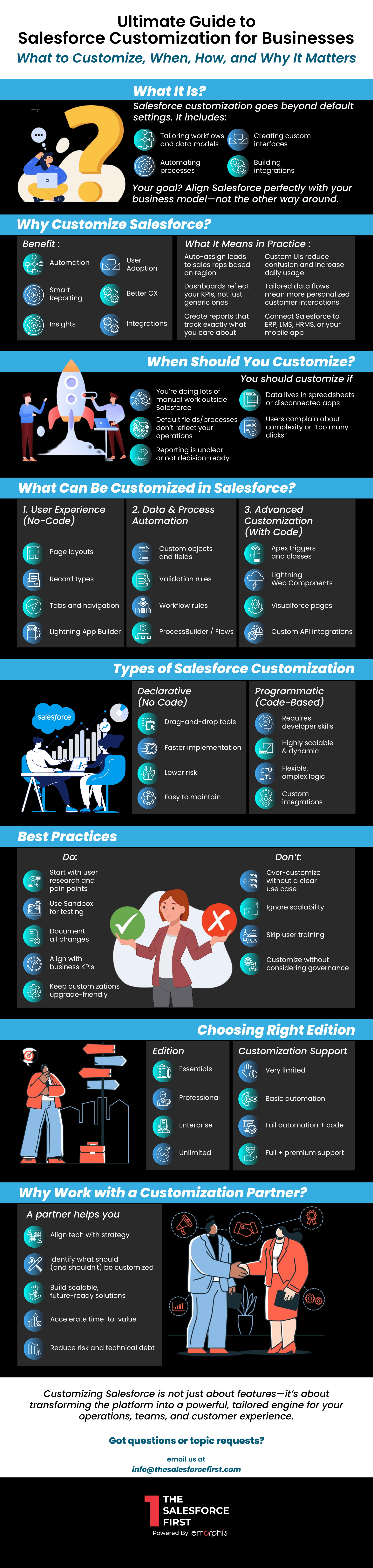
Take a look at an infographic for customization needs. Contact us for more details.
How Customization and Integration Maximize the Use Cases of Salesforce Products
Across all clouds, customization ensures Salesforce reflects how a business actually operates, while integration ensures Salesforce does not function in isolation. Together, they unlock advanced use cases of Salesforce products such as:
- End-to-end customer journey visibility
- Automated cross-department workflows
- Real-time reporting across systems
- Scalable digital transformation
Conclusion: Making Salesforce Work for Your Business, Not the Other Way Around
Understanding the use cases of Salesforce products is the first step toward building a scalable and future-ready digital foundation. Salesforce offers powerful tools across sales, service, marketing, commerce, analytics, and platform development, but true value comes from strategic customization and seamless integration.
By investing in Salesforce customization services, businesses can tailor workflows, data models, and user experiences to their exact needs. By leveraging Salesforce integration services, they can connect Salesforce with the rest of their technology ecosystem. Together, these approaches transform Salesforce from a CRM into a unified business growth platform that adapts as the business evolves.
When implemented thoughtfully, the use cases of Salesforce products become not just functional capabilities, but long-term competitive advantages for any organization.
Contact us for more details.