


Overview
Salesforce has announced Claudeforce, an expanded strategic partnership with Anthropic that brings Claude’s advanced reasoning together with Salesforce’s customer data, workflows, business logic, actions, and governance.
Announced on August 26, 2026, Claudeforce is designed to move Salesforce beyond the traditional CRM interface. Instead of requiring users to navigate screens, reports, records, and workflows manually, the partnership allows AI to reason over Salesforce data and take governed actions directly from the interface where users already work.
The first major release from the partnership is Salesforce in Claude, a Claude plugin built specifically for sales teams. It launches with 37 prebuilt sales skills covering activities such as meeting preparation, pipeline reviews, deal health, account planning, and revenue workflows.
Salesforce in Claude is currently available to select pilot customers, with an open beta planned for September 2026.
What Is Claudeforce?
Claudeforce is not simply another Salesforce-AI integration.
Salesforce describes it as a partnership between Salesforce and Anthropic that combines Claude’s reasoning capabilities with the trusted business context already stored and governed within Salesforce.
This distinction is important.
Large language models can reason across complex information. However, they do not automatically understand a company’s customer relationships, sales processes, approval rules, pipeline history, or internal business logic.
Salesforce provides that context.
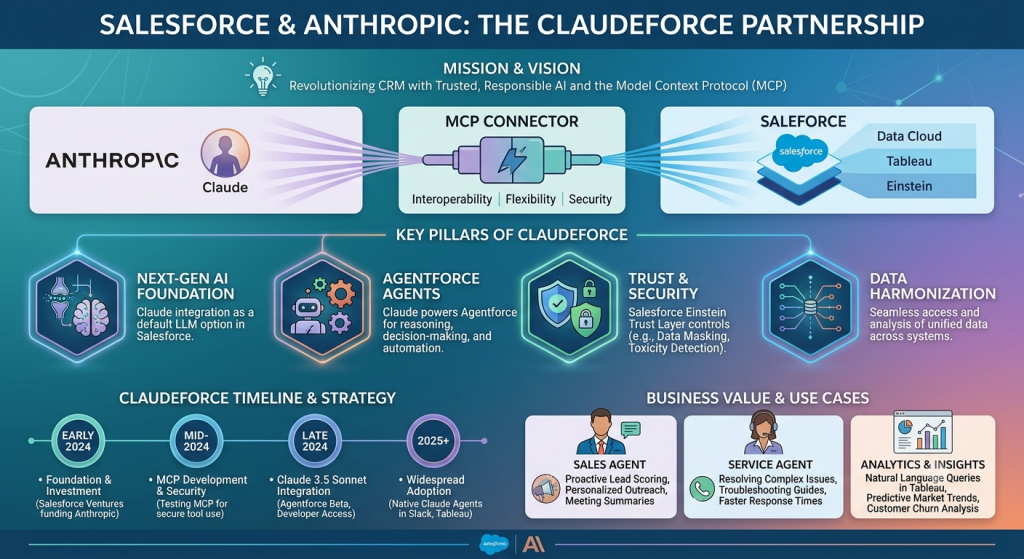
Through the Claudeforce architecture, Claude can work with Salesforce data while operating within existing Salesforce permissions and business rules. The goal is to connect AI reasoning with the deterministic systems that businesses already rely on.
Salesforce is positioning this as a shift in how enterprise software works.
Traditionally, software has provided an interface through which employees access information and execute workflows. With agentic AI, the software itself can become the infrastructure behind an AI-driven interface.
That means users may not always need to open Salesforce first.
They could ask Claude a business question, receive an answer grounded in Salesforce data, and then ask Claude to take the next action.
Salesforce in Claude: The First Claudeforce Product
The first product launched through the partnership is Salesforce in Claude.
The initial focus is sales.
Salesforce says the plugin includes 37 prebuilt sales skills developed jointly by Salesforce and Anthropic. These capabilities are designed around real sales workflows rather than generic prompts connected to a CRM API.
The skills cover different stages of the revenue cycle.
For example, sellers can use Claude to:
- Review their pipeline.
- Prepare for customer meetings.
- Analyze deal health.
- Build account plans.
- Identify expansion and renewal opportunities.
- Prepare deal strategies.
- Summarize customer conversations.
- Review sales activity.
- Identify opportunities requiring attention.
- Update Salesforce records.
- Execute selected workflows.
The idea is to give every seller an AI-powered revenue assistant that understands their accounts, opportunities, customer history, and current pipeline.
Salesforce calls this an “AI CRO” for every seller.
From CRM Data to Business Action
One of the most significant aspects of Claudeforce is that it is designed to go beyond answering questions.
For example, a salesperson might ask:
“What deals are at risk this week?”
A conventional AI assistant might analyze information available to it and provide a summary.
Salesforce in Claude is designed to reason over live Salesforce context, identify risks, and help determine what should happen next.
The seller could then ask Claude to update a record, create an account plan, or execute another permitted action.
The action is routed through Salesforce.
This matters because Salesforce remains the system enforcing the company’s business rules and permissions.
In other words, Claudeforce is not intended to create a parallel CRM.
Instead, Claude becomes another interface through which users can interact with Salesforce.

Headless 360: The Architecture Behind the Experience
A key technology behind the initiative is Salesforce’s Headless 360 architecture.
Salesforce describes Headless 360 as a way to expose Salesforce capabilities, including data, applications, workflows, business logic, and governance, directly to AI and other interfaces.
The architecture uses technologies including APIs, MCP servers, and CLI tools to make these capabilities accessible without requiring users to interact with the traditional Salesforce interface.
This creates an important architectural change.
Salesforce is effectively separating the capabilities of the CRM from its traditional user interface.
The underlying data and business logic can become services that AI agents call when needed.
That opens the door to Salesforce functionality appearing inside other applications.
Claude is one example.
Slack is another.
And Salesforce says more experiences are planned.
Claude Inside Salesforce
The partnership works in both directions.
While Salesforce in Claude brings Salesforce capabilities into Claude, Claude is also available inside Salesforce.
According to Salesforce, Claude is available in Agentforce as a reasoning model for the Atlas Reasoning Engine. It also powers Agentforce Vibes and Agentforce Coworker by default and is available through Agent Builder.
Salesforce also says Claude is available through Amazon Bedrock within the Salesforce Trust Boundary.
This is particularly relevant for organizations operating in regulated industries where data governance, privacy, security, and auditability are critical requirements.
The broader objective is to combine Claude’s reasoning capabilities with Salesforce’s enterprise controls.

Security and Governance Remain Central
Enterprise AI adoption has increasingly moved beyond model intelligence.
Organizations also want to know what data an AI system can access, what actions it can perform, and whether those actions follow existing policies.
Claudeforce puts significant emphasis on this area.
Salesforce says every answer and action in Salesforce in Claude operates according to the user’s existing Salesforce permissions and business rules.
Claude is therefore expected to see only the information a user is authorized to access and perform only the actions that user is authorized to perform.
Salesforce also says administrators can connect Salesforce in Claude once, with authentication and permissions managed centrally.
That eliminates the need to create a completely separate permissions framework for every employee.
The approach is particularly important as enterprises move from AI assistants that provide recommendations toward AI agents that can actually execute workflows.
The more autonomy an AI system receives, the more important governance becomes.
Claude and Slack Strengthen the Agentic Workplace
Claudeforce also expands the role of Claude within Slack.
Salesforce says Claude is being used across Slack to support productivity, team decision-making, and collaborative development.
Claude Tag can act as an AI teammate within Slack, while Slack Code brings AI agents and developers together in shared coding environments.
This creates an interesting three-part workflow.
A conversation can begin in Slack.
The team can use Claude to reason about the issue.
Salesforce can then provide the underlying customer or business context.
Finally, governed actions can be executed against Salesforce without requiring users to leave their workflow.
This is consistent with Salesforce’s broader vision of an agentic enterprise where people, AI agents, applications, and data operate together.
Claudeforce Will Extend Beyond Sales
Sales is only the starting point.
Salesforce’s Claudeforce roadmap lists several additional areas planned for future releases.
These include:
Service
Future capabilities are expected to support case-based agent setup, contact center optimization, and improvements to service operations.
Marketing
Salesforce plans to bring customer and business context into campaign creation, personalization, content development, and campaign optimization.
Commerce
Future capabilities are expected to support storefront creation, site operations, threat investigation, and order management.
Revenue
Salesforce plans to extend Claude’s capabilities into pricing, quoting, product configuration, and revenue workflows.
Field Service
The roadmap includes autonomous scheduling, asset service campaigns, guided troubleshooting, and frontline operational support.
Tableau
Claude is expected to work with trusted business semantics and analytics, including alerts around important metrics.
MuleSoft
Salesforce plans to use the partnership to help organizations manage agents, MCP connections, governance, and AI-driven actions.
Data 360
Data 360 is expected to provide unified business context for agents operating across different systems.
Industries
Salesforce also plans to bring industry-specific workflows and agents into the broader Claudeforce ecosystem.
This roadmap suggests that Salesforce does not view Claudeforce as a single CRM feature.
Instead, it is positioning the partnership as a broader interface between enterprise software and frontier AI.
What Claudeforce Means for Salesforce Customers
For Salesforce customers, the biggest change may be how users interact with CRM systems.
Employees have traditionally learned how to navigate Salesforce.
They learn objects, fields, reports, dashboards, flows, screens, and processes.
Agentic interfaces can reduce some of that dependency.
Instead of asking users to know where information lives, AI can retrieve relevant information based on the user’s intent.
Instead of requiring employees to complete every step manually, AI can execute approved actions.
This could make Salesforce more accessible to occasional users while increasing productivity for experienced users.
However, implementation will still matter.
Organizations will need clean data, clearly defined business rules, strong governance, and well-designed workflows.
AI cannot compensate for poor CRM architecture.
In fact, increased AI usage could make data quality even more important because agents will increasingly rely on CRM records to make decisions and execute actions.
A New Competitive Dynamic for Enterprise AI
Claudeforce also reflects a broader shift in the enterprise technology market.
CRM platforms are no longer competing only on applications, dashboards, automation, and data.
They are increasingly competing on how effectively AI agents can use those capabilities.
At the same time, AI companies are moving beyond standalone chat interfaces.
They need access to enterprise data, workflows, permissions, and actions if their models are going to become part of everyday business operations.
Salesforce brings enterprise applications and trusted business data.
Anthropic brings Claude’s reasoning capabilities.
Claudeforce attempts to connect the two.
That makes the partnership strategically significant beyond Salesforce’s CRM business.
Salesforce Is Using It Internally Too
Salesforce says it is acting as a “Customer Zero” for the technology.
The company’s own sales teams have reportedly used Salesforce in Claude with real pipeline, accounts, and deals.
Salesforce says its internal use helped shape the product and its prebuilt skills.
The company also says Claude is the default model across several internal and Salesforce products, including Slackbot, Salesforce in Claude, Headless 360, Agentforce Coworker, and Claude Code across its engineering organization.
This internal adoption is important because it gives Salesforce an opportunity to test the technology in real enterprise workflows before broader customer availability.
When Will Salesforce in Claude Be Available?
Salesforce in Claude is currently available to select pilot customers.
Salesforce expects the product to enter open beta in September 2026.
Additional prebuilt skills are expected to launch later in 2026, while capabilities for service, marketing, commerce, revenue, field service, Tableau, MuleSoft, Data 360, and other areas are planned for future releases.
The exact availability and packaging may vary by customer, region, and agreement.
The Bigger Picture: Salesforce Is Becoming More Than a CRM Interface
Claudeforce may ultimately prove important for a reason that extends beyond Claude or Salesforce.
It represents another step toward a model where enterprise software becomes infrastructure for AI agents rather than simply a collection of applications employees operate manually.
The CRM remains the system of record. The workflows remain governed. The permissions remain in place. But the interface can increasingly become conversational and agentic.
That is the core idea behind Claudeforce.
Salesforce brings the trusted business context. Claude brings advanced reasoning.
Together, the two companies are attempting to create an enterprise environment where AI does not simply tell employees what is happening.
It can understand the business context, recommend what should happen next, and, where authorized, take action.
For Salesforce customers, that could mark a meaningful change in how teams sell, serve customers, analyze data, and operate their businesses.
And with the initial sales release expanding into other Salesforce clouds and platforms, Claudeforce could become one of the more significant developments in Salesforce’s broader transition toward the agentic enterprise.
Further read details on How Salesforce Became the No. 1 Agentic CRM Platform.